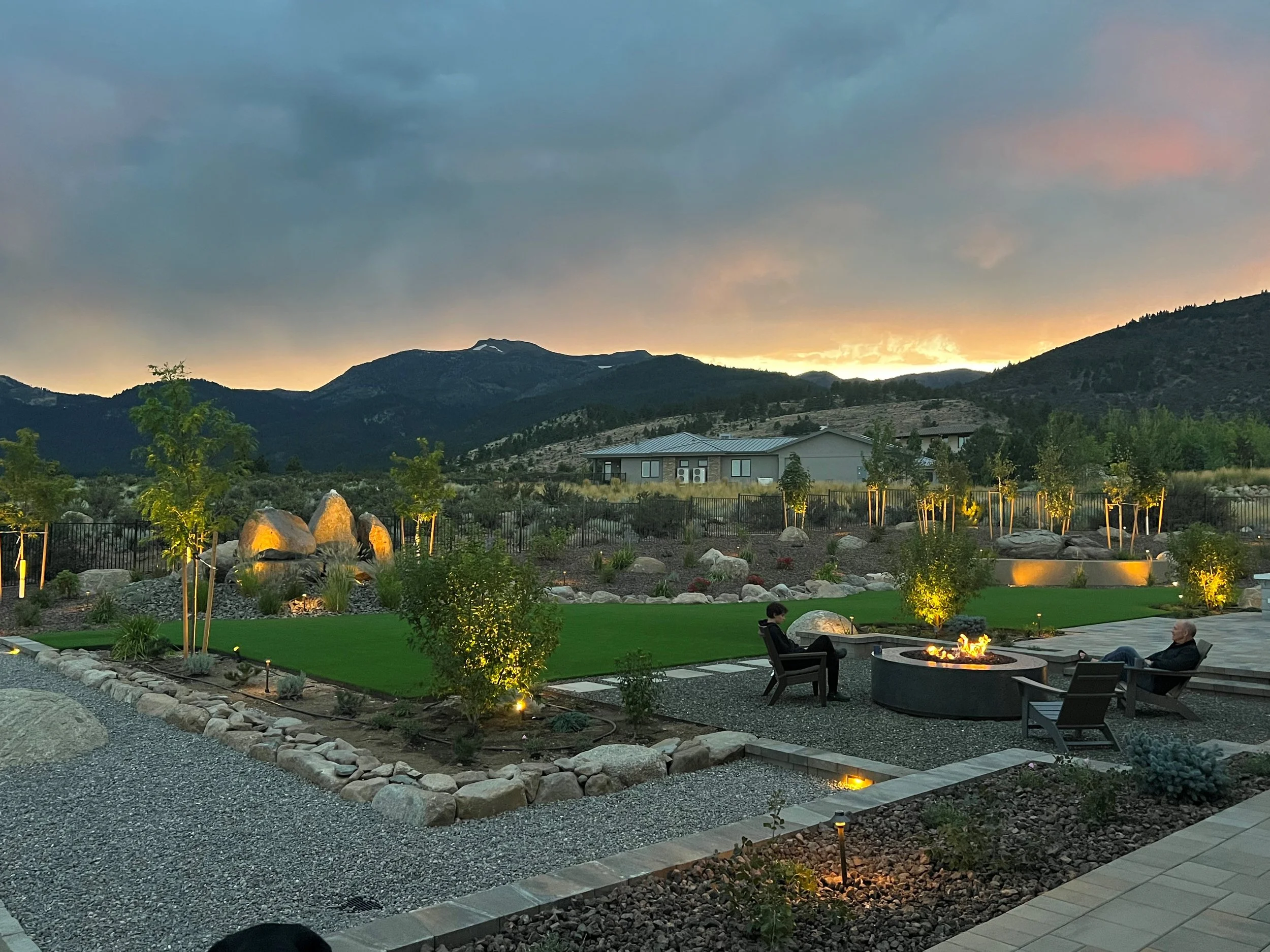
Twelve months in the high desert leaves a narrow window for most of the work a property needs, and landscaping services in Sparks, NV succeed or fail on using that window in the right order. Ground that is frozen in January, planting that wants April, hardscape that runs through summer and a snow season that starts before the last project closes all compete for the same calendar.
FireSky Outdoor founder Ron DuHamel brings degrees in fine arts, architecture, and landscape architecture, and our work carries Nevada Landscape Architect license number 913. A landscape architect leading the design changes what the schedule looks like, because the drawing settles grading, drainage, utilities and planting as one document rather than as four separate decisions made by four trades in sequence.
This guide sets out how a full year of work on a northern Nevada property is ordered, which services belong in which season, and what a homeowner gains by having the whole sequence drawn before any of it starts.
Related: These Landscaping Services Can Boost the Look of Your Front Yard in Spanish Springs, NV
What Does a Landscape Architect Settle Before the Season Starts?
A landscape architect settles elevations, utility routes and the planting list before the season starts, beginning with elevations. Where water currently goes, where it should go, and what the finished grades have to be for that to happen are the questions that constrain everything built afterward, and getting them wrong is expensive to correct once a patio is set.
Utilities come next. Gas for a fire feature, power for lighting, water for irrigation and any low voltage runs all need routes that do not conflict with footings, root zones or future phases. Drawn together, they share trenches. Decided in the field, they cross each other.
Planting is specified against the finished conditions rather than the existing ones. A bed that will sit above a new retaining wall has different exposure, drainage and reflected heat from the ground it occupies today, and the plant list has to answer the future condition.
Our design and build process produces that single document, which is also what makes phasing possible. A property can be built in three stages across three years without the third stage contradicting the first, because every later phase is measured against the same drawing.
Why Does the High Desert Compress the Build Season in Sparks?
Frost depth and a short shoulder season compress the build season in Sparks. Excavation, footings and base work need workable ground, and in the Truckee Meadows that rules out a meaningful stretch of the year. What remains has to carry excavation, hardscape, planting and the finish work on every project in the book.
Temperature swings inside a single day add their own constraint. Masonry and concrete behave differently when an afternoon is warm and the night drops near freezing, which affects curing and sometimes sets the working hours rather than the working months.
The practical effect is that position in the queue is worth real money. A property with an approved design and a signed scope in November typically gets scheduled ahead of one that starts its design in April, for identical work.
Which Landscaping Services Belong to Which Part of the Year?
Design belongs to winter, hardscape to the main build season and planting to the shoulder seasons. Design and documentation take weeks of calendar time and almost no field time, and they are the only part of a project that proceeds happily while the ground is hard.
Hardscape takes the main build season. Patios, walls, steps, fire features, outdoor kitchens and the trenching that serves them are sequenced together because they share excavation and base work.
Planting takes the shoulders. Spring and early autumn both give new plants a stretch of moderate temperature to establish roots before heat or cold arrives, and in a high desert climate that establishment period often decides survival more than the species choice does.
Where Does Landscape Maintenance Fit in the Yearly Schedule?
Landscape maintenance runs underneath the whole schedule rather than beside it. Our specialty landscape maintenance covers irrigation tuning and seasonal adjustments, pruning and planting care, which keep a finished property looking like it did on handover and catch problems while they are still small.
A property built and then left alone for two seasons needs remedial work rather than maintenance. The difference in cost between the two is large enough that we raise it during design rather than at handover.
How Does Water Shape a Northern Nevada Landscape Design?
Water shapes plant selection, bed layout and irrigation zoning together in a northern Nevada design. Plants with similar water needs are grouped so one zone serves them properly, because a zone running to satisfy the thirstiest plant in it drowns everything else.
Exposure makes the zoning harder than it looks. A south-facing bed against a light-colored wall carries reflected heat and dries far faster than a north-facing bed twenty feet away, and treating them as one zone means one of them is wrong.
Grading carries the other half. Water that runs off a hard surface goes either into a planted area that wants it or into a drain that takes it away, and deciding which at the drawing stage is cheaper than retrofitting either.
What Does Snow Removal Change About a Sparks Landscape Design?
Snow removal changes where features can go on a Sparks property. A drive, a walk and an entry have to be clearable, which means somewhere for pushed snow to go and no feature sitting in that path. Planting beds along a drive edge take the pile every winter unless the design accounts for it.
Surface choice follows from the same thinking. Materials that tolerate plow blades, de-icing treatments and repeated freeze cycles belong where clearing happens, and the more delicate finishes belong where they are walked on rather than scraped.
Drainage at the melt is the part that gets overlooked. A pile of cleared snow melts into whatever is downhill of it, and a design that sends that water across a patio or against a foundation has created a problem that only appears in February. Our residential snow removal is planned against the same drawing rather than bolted on in November.
Related: Backyard Landscaping in the High Desert Follows a Different Set of Rules Than Anywhere Else
How Should a Property Be Phased Across Several Years?
A property should be phased with infrastructure first and finish work last. Grading, drainage, utility runs and anything buried belong in phase one even where the feature they serve is three years away, because a sleeve laid under a future patio costs almost nothing and a trench cut through a finished one costs a great deal.
Structure comes next. Walls, steps and the main surfaces set the shape of the property, and everything else is arranged around them. Phasing these ahead of planting also avoids the familiar outcome of mature beds being trampled by a later build.
Planting and lighting are the natural last phases, because both are additive and neither disturbs what came before. A property looks complete at the end of phase two and better at the end of phase three.
What Does an Outdoor Kitchen Need Designed Around It?
An outdoor kitchen needs its utilities, wind shelter and circulation space designed around it before the counter is drawn. Gas, power, water and drainage all have to reach the island, and retrofitting any of them into a finished patio means lifting the surface along the whole run.
Wind matters more here than in most climates. An exposed counter at the open end of a yard is unusable on the evenings it is most wanted, so siting it behind a structure, a wall or a planting mass is a design decision rather than a furnishing one.
Circulation is the quiet requirement. People stand at a counter, and the space behind them has to let others pass without a queue forming. Our outdoor kitchen design work dimensions that standing space first, which is what separates a counter people use from a counter people admire.
What Does Soil in the Truckee Meadows Ask For?
Soil in the Truckee Meadows asks for amended beds and careful site investigation. Native ground here tends to be thin, alkaline and fast-draining, with decomposed granite and cobble not far below the surface. That is excellent for structural base material and difficult for planting, because water and nutrients move through it faster than most ornamental species use them.
Bed preparation is where that gets answered. Amending the planting medium, setting bed depths that hold moisture, and mulching to slow evaporation all do more for plant survival than irrigation volume does. Pouring more water onto unamended ground mostly waters the aquifer.
Excavation reveals the other half of the problem. Cobble and caliche layers slow digging, change the cost of a trench, and occasionally move a footing location. Our designers would rather find that during site investigation than during the week a crew is standing on the property.
Why Is Mulch a Structural Decision on a Sparks Planting Bed?
Mulch is a structural decision on a Sparks planting bed because the surface layer controls how much applied water reaches roots in low humidity and intense sun. Bare soil in a Sparks July loses moisture at a rate that makes any sensible irrigation schedule look inadequate.
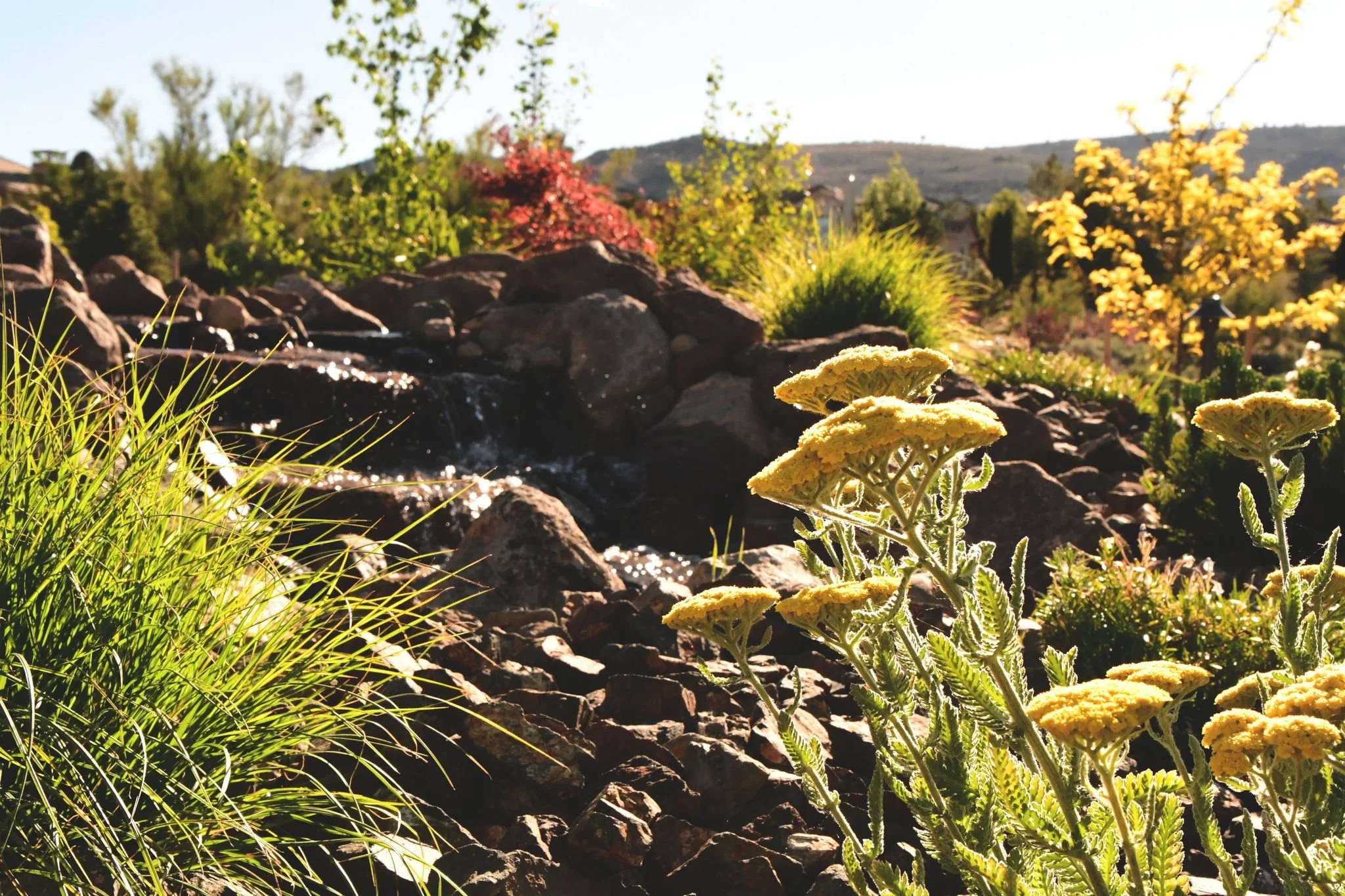
The material matters as much as the depth. Rock mulch holds and radiates heat, which suits some plantings and cooks others.
Organic mulch moderates soil temperature and breaks down into the bed over time, which is usually what a mixed planting wants, so the design specifies which bed gets which rather than defaulting to one across the property.
How Do Lighting and Outdoor Living Extend the Season in Northern Nevada?
Lighting, a fire feature and wind shelter extend the season by making cool northern Nevada evenings usable well into autumn. An evening here cools quickly even after a hot day, and a sheltered seating position with workable light is what turns an October evening into one people spend outside.
Lighting does the heavier lifting. Days are short through the back half of the year, and a property with no light simply stops existing at five in the afternoon. Even a restrained scheme on a few trees and the main seating area adds months of use.
Shelter is the other piece. Wind off the open ground is the usual reason a beautifully built terrace goes unused, and a wall, a structure or a planting mass placed on the prevailing side changes that for a fraction of what the terrace cost.
What Should a Homeowner Ask Before Signing a Landscape Proposal?
A homeowner should ask five questions before signing a landscape proposal, and all of them are answerable on paper.
The first four cover what the grading and drainage plan actually says in elevations rather than adjectives, what is included below the surface in excavation depth, base material and compaction, which utilities are in scope and which are assumed to exist, and what the finished condition of disturbed ground will be.
The fifth question is about who is doing the thinking. A proposal produced from a drawn plan answers all of these without hesitation. A proposal produced from a walkaround and a price per square foot tends to answer them later, on site, at somebody’s cost.
Our patio and walkway work sits inside that same documented process. That is the practical reason the answers are available before a crew arrives rather than after.
How Does a Sparks Property Hold Up After the Build?
A Sparks property holds up well after the build when irrigation, hardscape joints and planting each get attention on their own schedule. Irrigation is the first thing that drifts.
Heads get knocked, plants grow into spray patterns, and a controller programmed for a newly planted bed is wrong for the same bed two years later, which a seasonal check resets in a short visit.
Hardscape mostly looks after itself, with two exceptions. Joint material migrates over a few seasons and wants topping up, and anything that takes winter clearing wants an annual look for chipped edges and lifted units.
Planting changes the design on purpose. A bed that looked sparse at handover is doing what it was drawn to do by year three, and pruning in those years preserves the intended shapes rather than reducing overgrowth. That is a different job from cutting everything back to the same height.
Plan Landscaping Services in Sparks Before the Ground Opens
A high desert property gets built in a short season and designed in a long one, and the properties that go smoothly are the ones that used the winter. Our team would rather survey, draw and resolve the grading now, so the first workable week in spring is a build week rather than a discovery week.
FireSky Outdoor begins landscaping services on a Sparks, NV property with a survey and a drawing rather than a shovel. Schedule your landscape design consultation with FireSky Outdoor.
In Summary
How far in advance should a Sparks, NV project be designed?
A Sparks, NV project is comfortably designed two to four months ahead of the intended build start for most residential work. Survey, design, revisions, material selection and any permitting each take their own weeks, and they sequence rather than overlap. A design started in November is generally ready for the first workable ground in spring.
Can a property be built in phases without redoing work?
A property builds in phases without redoing work when the whole property is drawn before phase one begins. The infrastructure that later phases depend on, meaning grading, drainage and buried utility routes, goes in first even where the features it serves are years away. Phasing without that plan is how a second phase ends up cutting through a first.
Does a landscape architect have to be involved in a residential project?
A landscape architect earns a place on residential projects with real grade change, drainage that has to be solved, or several structures that share utilities, while small additions often go ahead without one. On those larger properties, FireSky Outdoor keeps the decisions consistent across trades and seasons by having the whole project documented by a licensed landscape architect.
Does FireSky Outdoor offer snow removal for homes in Sparks, NV?
FireSky Outdoor offers residential snow removal in Sparks, NV, clearing driveways, walkways and entryways. The service runs on 24/7 monitoring and response tied to real-time storms, with de-icing treatments for steps and paths.
Related: Ready to Take the Plunge? Get Your Pool and Spa Project Started With These Landscaping Services in Sparks, NV